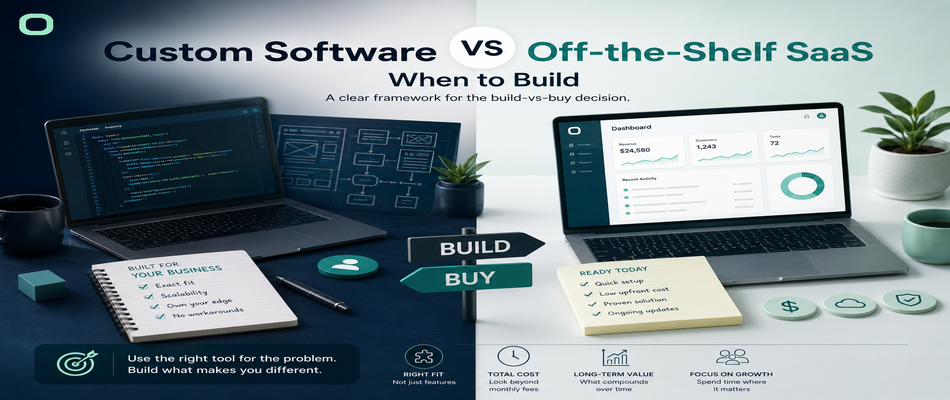
Every growing business hits this fork: keep paying for an off-the-shelf tool that doesn't quite fit, or build something custom that does exactly what you need? Both choices can be right. Both can be expensive mistakes. Here's a framework for deciding which is which.
The honest default: buy first
For most needs, an existing tool is the smart starting point. Someone has already solved the common version of your problem, maintained it for years, and spread the cost across thousands of customers. You get it today for a monthly fee, with no build time. Reaching for custom software too early is one of the more common and costly founder mistakes.
Build custom only when you can name the specific thing an off-the-shelf tool can't do and that thing actually matters to your business.
When off-the-shelf SaaS wins
- Your need is common. Email, invoicing, scheduling, basic CRM, these are solved problems. Buy.
- You need it now. A subscription works this afternoon; custom software takes weeks or months.
- The tool fits "well enough." If it does 90% of what you want, the missing 10% is rarely worth a custom build.
- It's not your differentiator. If the process isn't what makes your business special, you don't need to own it.
When custom software pays off
- The tool is your edge. When the software is how you're better than competitors, owning it is owning your advantage.
- Nothing off-the-shelf fits. Your workflow is genuinely unusual, and you're bending three tools (and a lot of spreadsheets) to fake it.
- The subscriptions have stacked up. When you're paying for several overlapping tools plus the manual glue between them, a custom build can cost less over time and work better.
- You've outgrown the tool's limits. You're hitting walls on data, users, or logic the platform won't bend on.
If you're stitching together tools and spreadsheets to run a core process, that's often the tell that you've outgrown what off-the-shelf can do for you.
The cost comparison people get wrong
Buying looks cheaper because the price is visible: a monthly fee. Building looks expensive because the cost is upfront. But the real comparison is over years, and it should include the things that don't show up on an invoice:
- Subscription fees across every tool, multiplied by every user, every month.
- The hours your team spends working around what the tools can't do.
- The cost of not having something that fits, slower work, errors, lost opportunities.
Sometimes that math favours buying for years. Sometimes it quietly crossed over to "build" a while ago and no one noticed. The point is to actually run it, not assume.
A middle path
It's rarely all-or-nothing. A common, sensible pattern is to buy the commodity pieces (email, payments, analytics) and build only the part that's truly yours, then connect them. You get the best of both: proven tools for solved problems, custom software only where it earns its keep.
How we approach build-vs-buy at LyfWis
Because we build custom software, you might expect us to push it. We don't, if an off-the-shelf tool will serve you well, that's what we'll say, and we'll happily point you to one. Custom is the right call only when it clearly beats buying, and a short, honest conversation usually makes that obvious. See what we build, or tell us what you're wrestling with and we'll give you a straight answer on whether it's worth building.
Frequently asked
Isn't custom software always better since it fits exactly?
Fit isn't free. You also take on the build time, the cost, and the upkeep. For common needs, a well-made existing tool beats a custom one you have to maintain forever.
How do I know I've outgrown a tool?
When you're paying for workarounds, extra tools, manual steps, or spreadsheets bridging the gaps and those workarounds are costing real time, you're likely past the point where buying still wins.
Can I start with SaaS and move to custom later?
Yes, and it's often the wise path: use off-the-shelf tools to learn exactly what you need, then build custom once the requirements are proven rather than guessed.