"Backend" is one of those words that gets used constantly and explained rarely. If you're planning a website or app, it helps to know what it actually means, because whether you need one shapes your timeline, your cost, and what your product can do. Here's the plain version.
Front end vs back end, in one line
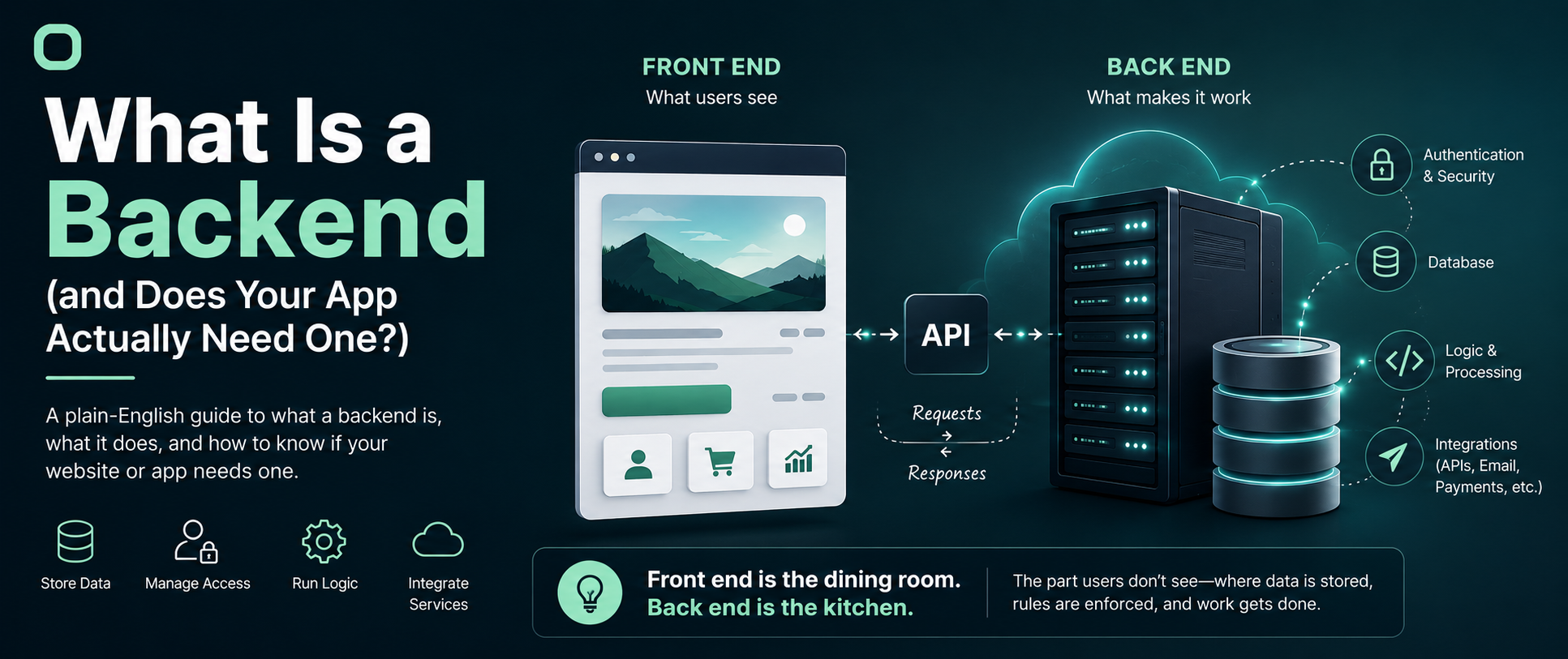
The front end is everything people see and touch: the pages, buttons, and layouts in their browser. The back end is the part they never see: the server, the database, and the logic that remembers things, enforces rules, and does work behind the scenes.
If the front end is the dining room, what guests experience; the back end is the kitchen, the storeroom, and the staff who make it all actually happen.
What a backend actually does
A backend handles the things that have to be remembered, protected, or processed away from the user's device:
- Stores data , accounts, orders, posts, settings, in a database that persists between visits.
- Handles accounts and access , logging people in, and making sure each person only sees what they're allowed to.
- Runs logic and rules , calculations, payments, sending emails, enforcing limits.
- Talks to other systems , payment providers, email services, and other tools, through APIs.
Does your project need one?
A useful test: does anything need to be remembered, shared between people, or kept secure? If yes, you need a backend. If your site only presents information, you may not.
You probably don't need a custom backend when:
- It's a marketing site, portfolio, or brochure, mostly content. (See website vs web app.)
- Your contact form can post to a simple service, with nothing else stored.
You almost certainly do need one when:
- Users log in and see their own data.
- You take payments, bookings, or orders.
- Different people need different permissions.
- Your product processes or stores anything sensitive.
What "BaaS" means
You'll hear the term Backend-as-a-Service (BaaS). It means using managed building blocks for database, authentication, file storage, and so on, instead of assembling every piece from scratch. Done well, it gets you a secure, scalable backend faster and cheaper. The catch is that "building with AI" or stitching together services without care can quietly create security and reliability problems. The value is in doing it legitimately , proper authentication, sensible data handling, and an architecture that won't fall over as you grow.
Why it matters for cost and trust
Backends are where the real engineering, and much of the cost and risk lives. A pretty front end on a shaky backend is a liability: it's where data leaks, downtime, and "it worked in the demo" failures come from. It's worth getting right rather than cheapest.
How we approach backends at LyfWis
We design backends to be safe, legitimate, and maintainable, the unglamorous parts that decide whether a product still works in two years. If you're not sure whether your idea needs one, that's a five-minute conversation; see what a backend engagement includes or just tell us what you're building.
Frequently asked
Can I add a backend later?
Sometimes, but it's usually cheaper to plan for it from the start if you know you'll need accounts or stored data. Retrofitting a backend onto something built without one can mean significant rework.
Is a database the same as a backend?
A database is one part of a backend, the part that stores data. The backend also includes the logic and the secure layer that decides who can read or change that data.
Does a backend make my site slower?
Not if it's built well. A good backend is fast and often improves perceived speed by doing heavy work on the server instead of the user's device.