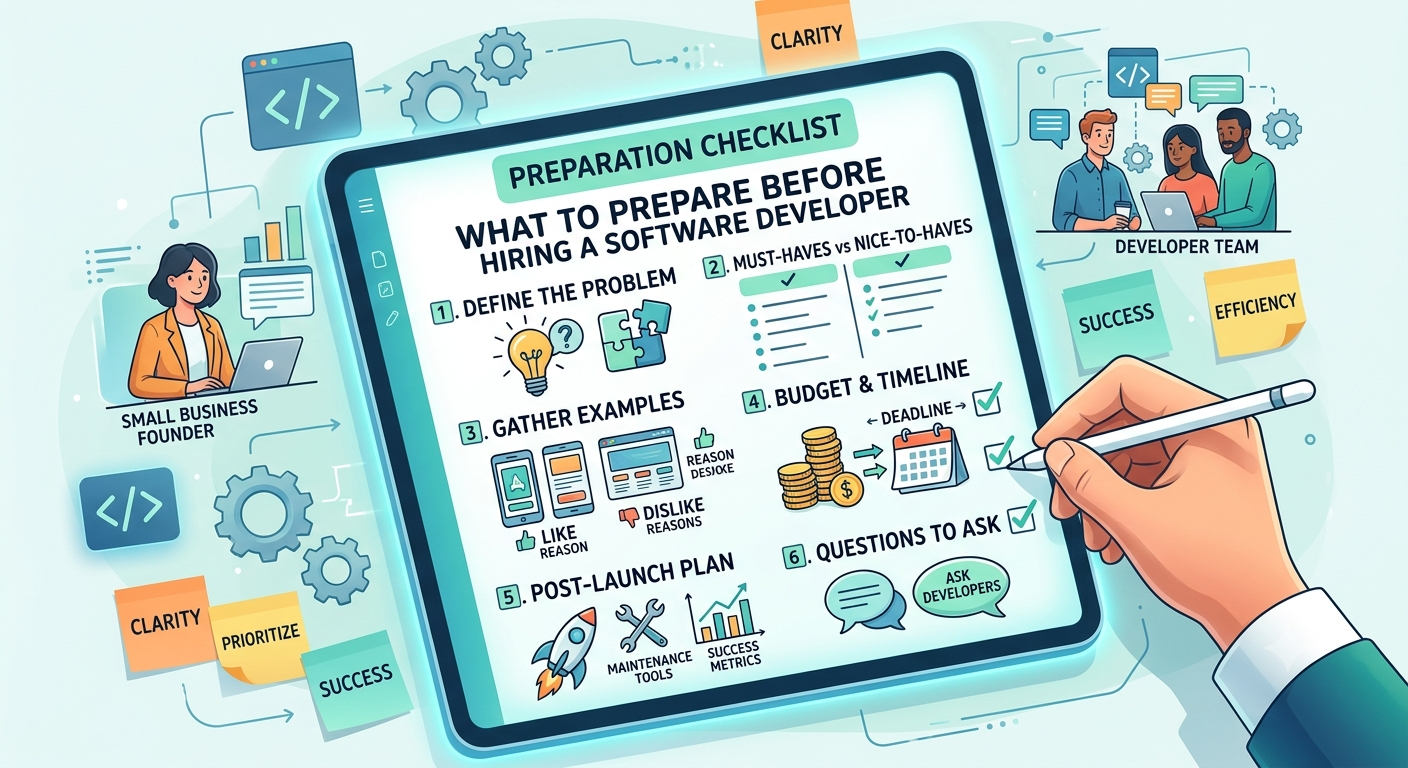
The biggest cause of software projects going haywire isn't bad code, it's a fuzzy starting point. The clearer you are before work begins, the faster and streamlined it goes, and the more likely you are to get what you actually wanted. You don't need a technical spec. You need to have thought a few things through. Here's what to prepare.
Why preparation saves money
Developers price uncertainty. When a brief is vague, a careful studio either builds in a buffer for the unknowns or spends paid hours discovering what you meant. Either way, ambiguity costs you. An hour of clear thinking before the project can save many hours of rework during it.
1. Define the problem, not the solution
It's tempting to arrive with a feature list. But the most useful thing you can bring is the problem: who is struggling, with what, and what happens today instead. A good studio will often propose a simpler, cheaper solution than the one you had in mind, but only if they understand the problem underneath it.
Bring the pain, not just the prescription. "Customers can't track their orders and we field 30 emails a day about it" is more useful than "build me a dashboard."
2. Separate must-haves from nice-to-haves
List what you want, then split it ruthlessly into two columns: what the product genuinely cannot launch without, and what would be nice eventually. This single exercise does more to control budget than any negotiation. It lets you launch the essential version sooner and add the rest once it's earning, see our take on building an MVP first.
3. Gather examples
Collect two or three products you admire and two or three you don't, and note why. Screenshots and links communicate taste and intent far faster than paragraphs. They also surface disagreements early, while they're cheap to resolve.
4. Be realistic about budget and timeline
You don't have to name a figure, but you should have a range in mind, because it shapes what's sensible to build. A studio that knows your rough budget can design to it instead of designing something you can't afford and trimming painfully later. If you'd like a sense of ranges before you talk to anyone, our pricing page lays out indicative numbers by type and region.
On timeline: most things take longer than they look from the outside, because the visible screens are only part of the work. Build in room, and prioritise the must-haves so there's always something shippable.
5. Think about what happens after launch
Software isn't a one-time purchase; it needs hosting, security updates, and the occasional fix. Decide up front who handles that, and ask any developer how they hand a project over. Two things worth settling in writing before you start:
- Ownership. Confirm you own the code and accounts when the work is done. (More on this in do you own your code?)
- Maintenance. Agree whether there's ongoing support and what it covers.
6. Questions worth asking any developer
- Who will actually do the work, and who's my point of contact?
- How do you handle changes once we've started?
- What do I own at the end, and how is it handed over?
- What happens after launch, and what does support cost?
- Can you show me something similar you've built?
You're not testing their cleverness; you're checking that the working relationship will be clear and honest. The answers tell you a lot.
A one-page brief is plenty
You can fit everything a developer needs onto a single page:
- The problem, and who has it.
- Must-haves vs nice-to-haves.
- Two or three examples you like, with a note on why.
- A rough budget range and any hard deadline.
- How you'll know it worked.
That last point matters: define success before you start, so everyone's building toward the same thing.
Working with LyfWis
If a one-page brief feels like a lot, don't worry; drawing it out is part of what we do at the start, and we'll happily tell you if the cheapest version of your idea is the right one. Have a look at how we work and what we build, and when you're ready, tell us what you're solving. Even a rough problem statement is enough to start a useful conversation.
Frequently asked
Do I need to know what technology should be used?
No. Choosing the right tools is the developer's job. Your job is to be clear about the problem, the priorities, and the constraints, they'll handle the rest.
What if I don't have a fixed budget?
A range is fine, even a wide one. The point isn't to commit a number; it's to let whoever you hire design something that's actually affordable to you rather than discovering the mismatch halfway through.
How detailed should my brief be?
One clear page beats ten vague ones. Focus on the problem, your priorities, and what success looks like. A good studio fills in the technical detail with you.