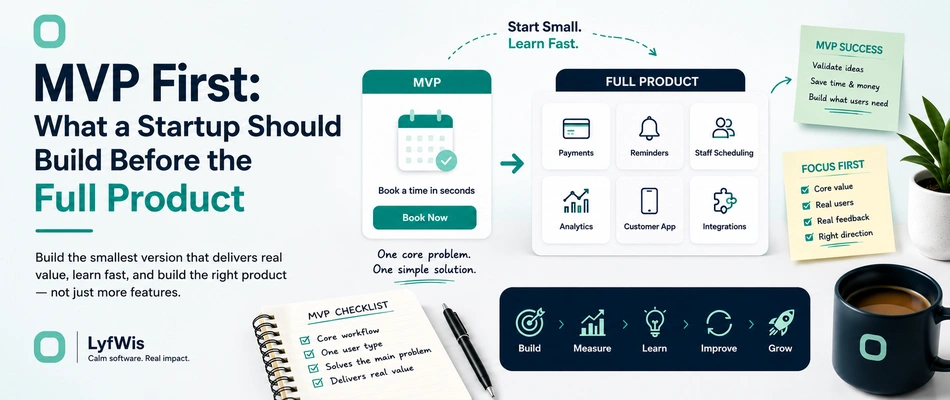
Almost every founder we meet has a fuller product in their head than the one they should build first. That instinct is natural,and expensive. The fix is an MVP: the smallest version of your idea that's genuinely useful to real people. Here's what that means in practice, and how to decide what makes the first cut.
What an MVP actually is
MVP stands for minimum viable product. The important word is viable, not minimum. An MVP isn't a half-built, broken version of your product; it's a complete, polished version of a smaller product. It does one core thing well, end to end, for one type of user.
An MVP is the smallest thing you can build that someone would actually use and, ideally, pay for. Not a demo, not a prototype, a real, working slice.
Why build less first
Building the full vision up front assumes you already know exactly what users want. You usually don't; not because you're inexperienced, but because nobody does until real people start using the thing. An MVP turns expensive assumptions into cheap lessons:
- It's faster and cheaper to launch, so you start learning sooner.
- It tells you what to build next based on real usage, not guesses.
- It protects your budget , you invest in the features people actually use, not the ones that seemed important on a whiteboard.
The most costly software isn't the feature that took too long. It's the feature nobody needed, built beautifully.
How to decide what's in
Start from the one job your product must do, then strip everything that isn't required to do that job. A simple test for each feature: if this were missing, would the product still solve the core problem? If yes, it can wait.
This is the same must-have versus nice-to-have split we cover in what to prepare before hiring a developer applied ruthlessly. A useful framing:
- In the MVP: the single core workflow, done properly, for one user type.
- Right after: the obvious next features users will ask for.
- Later: the things that only matter at scale such as admin tooling, integrations, edge cases, multiple user roles.
What an MVP is not
Cutting scope doesn't mean cutting quality. An MVP should still be reliable, clear, and trustworthy, those aren't features you trim, they're the baseline. A flaky, confusing MVP doesn't teach you whether people want your product; it only teaches you that they didn't want that. Keep the surface small, but make it solid.
A quick example
Say you're building a booking tool for a niche of service businesses. The full vision has payments, reminders, staff scheduling, analytics, and a customer app. The MVP is probably just this: a business can list their availability, and a customer can book a slot and get a confirmation. That's it, but it's a complete, working loop you can put in front of ten real businesses next month instead of next year.
How we approach MVPs at LyfWis
Part of our job at the start is helping you find that core loop and resist the urge to build everything at once. We'd rather ship you something small that earns its keep and grows than something sprawling that drains the budget before launch. Have a look at how we work, or tell us what you're trying to build and we'll help you find the smallest version worth starting with.
Frequently asked
Won't a small launch make us look unfinished?
Not if it's polished. Users judge whether the thing in front of them works well, not whether a roadmap exists behind it. A focused product that does one thing cleanly reads as confident, not incomplete.
How do I know when to add more?
Let usage decide. When real users repeatedly ask for the same thing, or you can see them working around a gap, that's your signal, and it's far more reliable than guessing in advance.
Is an MVP cheaper than a full build?
To launch, almost always because you're building less. Over time you'll likely invest more in total, but you'll spend it on the right things, guided by real feedback rather than assumptions.