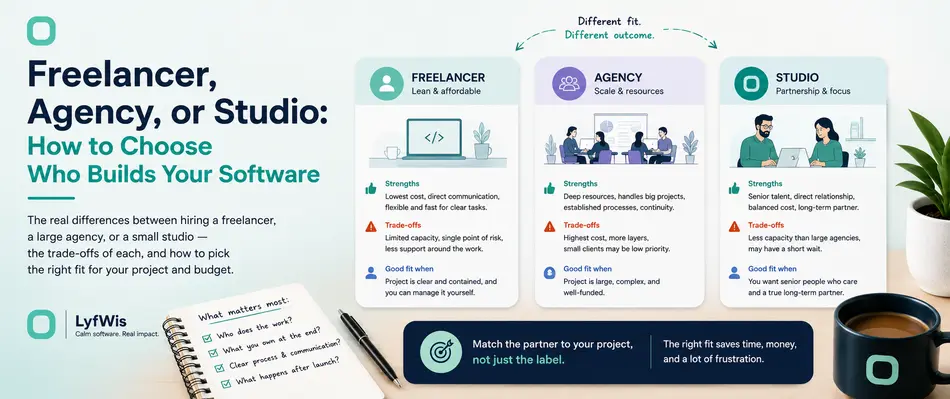
Once you've decided to build something, the next question is who builds it. The usual options are a freelancer, a large agency, or a small studio and they aren't better or worse in the abstract; they're suited to different projects. Picking the wrong fit is a common and avoidable source of frustration. Here's how they really differ.
Freelancers
A freelancer is a single skilled person you hire directly. For the right project, it's the leanest, most affordable option.
Strengths: lowest cost, direct communication with the person doing the work, flexible and fast for well-defined tasks.
Trade-offs: limited capacity (one person, one set of skills), a risk if they get sick or move on, and usually less help with the surrounding pieces like strategy, design, ongoing maintenance.
Good fit when: the project is clear and contained, you can describe exactly what you need, and you're comfortable managing it yourself.
Large agencies
A big agency brings a whole team, the designers, developers, project managers, strategists and the structure to run large, complex projects.
Strengths: deep resources, can handle big and complex work, established processes, continuity if someone leaves.
Trade-offs: the highest cost, more layers between you and the people actually building, and small clients can end up a low priority behind the agency's largest accounts.
Good fit when: the project is large and well-funded, and you value process and scale over a close, direct relationship.
Small studios
A studio sits between the two: a small, senior team that takes on a limited number of projects at once.
Strengths: you work directly with the people building your product, you get design and engineering and judgement without big-agency overhead, and you're a real client rather than account number 400.
Trade-offs: less raw capacity than a large agency, and because good studios take on few projects at a time, the right one may have a short wait.
Good fit when: you want senior people who care, a direct relationship, and a partner who'll still be there after launch, without paying for agency layers you don't need.
How to choose
Match the option to your project, not to a label:
- Small, clear, budget-tight? A freelancer may be all you need.
- Large, complex, well-funded? A big agency has the resources.
- Want a real partnership and senior judgement without the overhead? A studio is built for exactly that middle.
Whichever you lean toward, the questions to ask are the same, who does the work, what you own at the end, and what happens after launch. We cover those in what to prepare before hiring a developer and in do you own your code?
The thing labels don't tell you
"Freelancer," "agency," and "studio" describe size, not quality. There are excellent freelancers and disappointing agencies, and vice versa. Beyond the category, look for the same signals everywhere: do they ask good questions about your problem, are they clear about ownership and process, and can they show you real work? Those tell you more than the label ever will.
Where LyfWis fits
LyfWis is a small studio by design. The people you talk to are the people who build, we take on a limited number of projects so each gets real attention, and we build for the long term rather than the handoff. If that sounds like the right fit, see how we work or start a conversation and if a freelancer or a big agency would genuinely serve you better, we'll tell you that too.
Frequently asked
Is a freelancer always cheaper than a studio?
Usually on the headline rate, yes. But "cheaper" depends on the whole picture, a studio bundles design, engineering, and judgement that you might otherwise hire (and coordinate) separately. For a contained task, a freelancer wins on cost; for a product, the math is closer.
What's the risk with a solo freelancer?
Mainly continuity and capacity; one person can only do so much, and if they become unavailable, your project stalls. It's very workable for the right scope; just go in aware of it.
Why would I pick a studio over a big agency?
Directness and care. With a studio you work with senior people building your product, without the layers, cost, and "small fish" feeling that can come with a large agency.