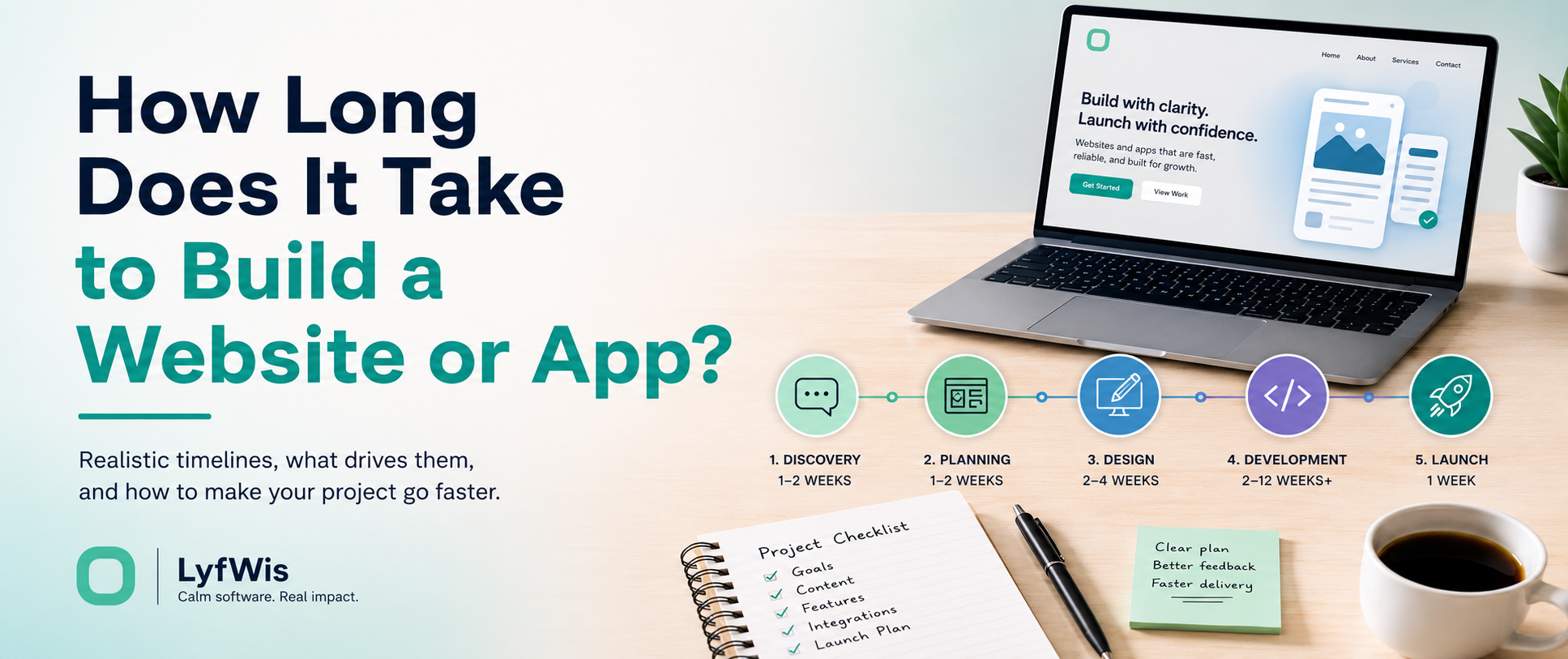
"How long will it take?" is one of the first questions founders ask, and the honest answer is the one nobody loves: it depends. But it depends on knowable things. Here's a realistic picture of what drives a timeline, rough ranges by project type, and how to make yours move faster.
What actually drives the timeline
The number of screens you can see is a small part of the work. What really sets the pace is everything behind them:
- Complexity. A marketing site is faster than a store; a store is faster than a custom app with accounts and logic.
- Clarity. A clear brief moves fast. A vague one spends its first weeks just figuring out what to build.
- Content readiness. Waiting on copy, images, and product data is one of the most common causes of delay, and it's on your side, not the developer's.
- Decisions and feedback. Projects move at the speed of their slowest approval. Quick, clear feedback keeps momentum.
- Integrations. Payments, third-party systems, and data migrations each add time.
Rough ranges
Every project is quoted with its own timeline, but as a general sense of scale:
| Type | Typical range | Main driver |
|---|---|---|
| Landing page | 1–2 weeks | Content & design rounds |
| Marketing website | 3–6 weeks | Number of pages, content |
| E-commerce store | 3–8 weeks | Catalogue size, integrations |
| Custom web app (MVP) | 2–4 months | Features & logic |
| Larger custom platform | 4+ months | Scope & scale |
These are starting points, not promises. A "simple" site with unusual requirements can take longer than a larger one that's well defined.
Why estimates vary so much
Two developers can quote very different timelines for the "same" project because they're picturing different products. One imagines a template-based site; the other, a custom build. Neither is wrong; they're estimating different things. This is exactly why a clear brief and a frank conversation about scope matter so much; see what to prepare before hiring a developer.
How to make your project go faster
- Have your content ready or know who's producing it and when. This is the most common avoidable delay.
- Start smaller. Launching a focused first version (an MVP) gets you live sooner, then you add to it.
- Give feedback in batches, promptly. Scattered, slow notes stretch a project more than any technical hurdle.
- Lock the must-haves. Mid-build scope changes are the biggest source of "why is this taking so long?"
A word on rushing
Faster isn't free. Genuine speed comes from a tighter scope and good preparation, not from cutting testing or skipping the unglamorous work that keeps software stable. A site shipped a week early but broken on mobile costs more than the week it saved.
How we approach timelines at LyfWis
We'd rather give you an honest range than an optimistic one we both regret. After a short conversation about scope, we map the work into milestones so there's always something taking shape and no mystery about where things stand. See how we work, or tell us what you're building and we'll give you a realistic timeline for it.
Frequently asked
Can you build my site in a week?
Sometimes a focused landing page with ready content can move very fast. A store or app can't be rushed into a week without cutting corners you'd regret. The right question isn't "how fast," but "how fast for something built well."
What slows projects down most?
Not having content ready, and slow or scattered feedback. Both are on the client side, and both are easy to fix with a little preparation.
Does a bigger budget mean a faster build?
Up to a point, but not linearly; some work simply takes the time it takes, and adding people to a small project can slow it down rather than speed it up. Clarity buys more speed than money does.