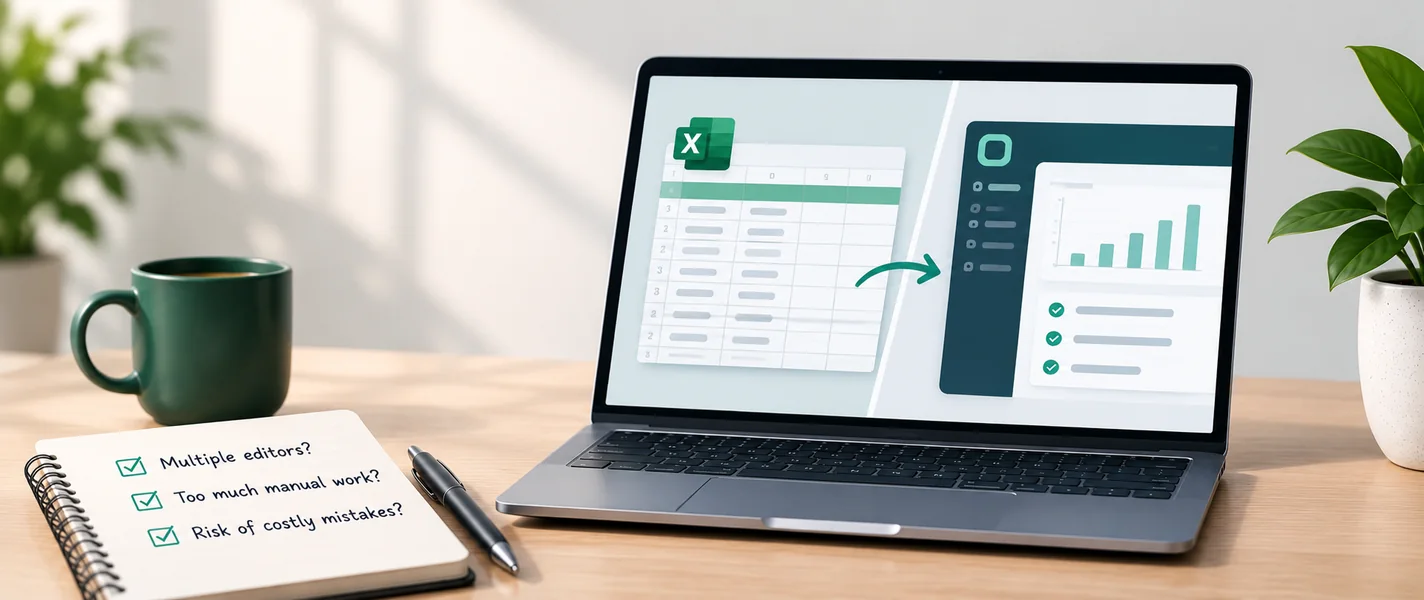
Spreadsheets are quietly running an enormous share of small businesses, bookings, inventory, clients, finances, the lot. And for a while, that's completely fine. A spreadsheet is free, instant, and flexible. The trouble starts later, gradually, until one day the tool that got you here is the thing holding you back. Here's how to recognize that moment.
Why we all start with spreadsheets
There's no shame in it, starting with a spreadsheet is often the right call. It costs nothing, needs no developer, and lets you figure out how your process actually works before committing to anything. Many good custom tools begin life as a spreadsheet that proved what was needed. The skill is knowing when you've outgrown it.
The signs you've outgrown it
- Several people edit it and you're fighting over versions, overwriting each other, or emailing "the latest one" around.
- One wrong cell causes real damage, a deleted row or a broken formula has actual business consequences.
- You do the same manual steps daily, copying, reformatting, re-sending, that a tool could just do.
- It's becoming a liability, sensitive customer or financial data sitting in a file that's easy to leak, lose, or misshare.
- You can't get answers from it, reporting means hours of manual wrangling instead of a glance.
- It's fragile, only one person truly understands it, and everyone fears the day they're away.
One or two of these is normal. Several at once is the spreadsheet telling you it's done its job.
What you move to (and what it costs you to wait)
The usual next step is a simple custom tool, a small web app shaped around your exact process. Instead of a shared file, you get proper accounts and permissions, validation that prevents bad data, automation of the repetitive steps, and reporting that's a click rather than an afternoon.
The cost of waiting too long is rarely dramatic, it's the slow drain of hours lost to manual work, the occasional expensive mistake, and the risk sitting in an unprotected file. At some point the spreadsheet costs more in wasted time and risk than a proper tool would.
A spreadsheet is a brilliant way to start and a risky way to scale. The goal isn't to abandon it early, it's to notice when it has quietly become the bottleneck.
You don't have to replace everything at once
Moving off a spreadsheet doesn't mean a giant system overnight. The sensible path is to build the smallest tool that fixes your biggest pain first, the one process that's costing you most, and grow from there. That keeps the cost manageable and lets you keep working while it's built. It's the same build-the-essential-version-first thinking that works for any software.
How we approach this at LyfWis
Turning a messy, overgrown spreadsheet into a calm, reliable tool is one of our favourite kinds of project, the relief is immediate and the time saved is real. We start by understanding the process you already have (your spreadsheet is the brief), then build something that fits it. If a spreadsheet is starting to creak, tell us what it's tracking and we'll suggest the smallest useful first step, or see what we build.
Frequently asked
Isn't custom software expensive compared to a free spreadsheet?
It has a real cost, but so does the spreadsheet once you count the hours lost to manual work and the risk of mistakes. The right time to switch is when those hidden costs exceed the price of a proper tool, which a small first build keeps modest.
Can I keep my data when I move?
Yes. Your existing spreadsheet data can almost always be imported into a new tool, so you're not starting from a blank slate.
What's the smallest way to start?
Pick the single process that hurts most and build a tool for just that. It proves the value quickly, keeps the cost low, and gives you something to grow from rather than a risky big-bang replacement.