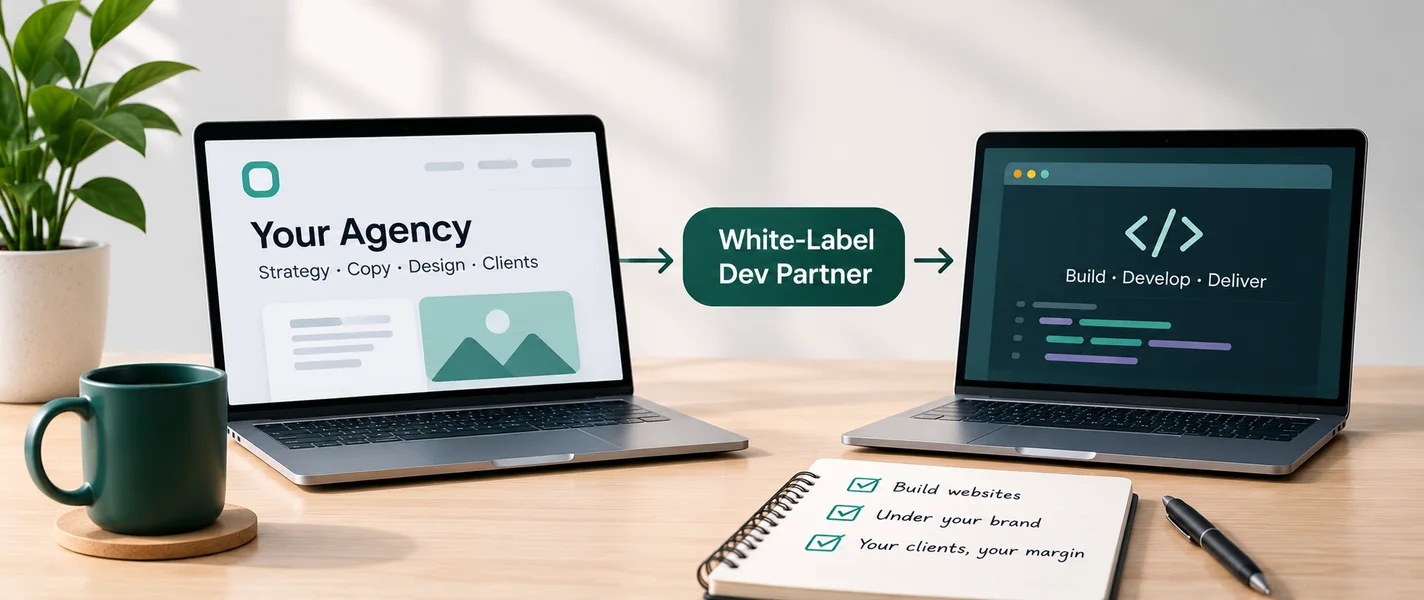
Plenty of agencies sell websites without employing a single developer. A copywriting studio writes the words, a brand studio designs the look, a marketing agency runs the campaigns, and somebody else quietly builds the thing. That somebody is a white-label development partner. Done well, it lets an agency offer complete projects without hiring. Done badly, it puts the agency's reputation in the hands of a stranger. Here's how the arrangement really works.
What "white-label" means
A white-label partner builds work that goes out under your agency's name. Your client deals with you; the partner works behind the scenes, or alongside you as part of "your team," depending on what you prefer. You own the client relationship, set the price, and keep the margin. The partner owns the build.
The client hires your agency. Your agency hires the partner. The client should experience one calm, joined-up team, not a hand-off.
Why agencies use a partner instead of hiring
- Uneven demand. Three website projects one month and none the next is a terrible pattern for a salaried hire, and a fine one for a partner.
- Breadth without headcount. One partner can cover marketing sites, stores, booking systems, and backends, skills that would take several hires.
- Saying yes to bigger work. When a client asks "can you build the whole thing?", the answer becomes yes instead of a referral to a competitor.
- Focus. The agency keeps doing what it's best at, strategy, words, design, relationships, rather than managing servers.
The common ways to structure it
| Model | How it works | Best for |
|---|---|---|
| Fully white-label | Partner is invisible; all client contact goes through you | Agencies with strong account management |
| Embedded | Partner joins calls as "our developer" under your brand | Technical projects where questions come up often |
| Referral | You introduce the client; partner contracts directly and may pay a referral fee | Occasional builds outside your core offer |
None of these is better in the abstract. Pick the one that matches how much client contact you want to own.
What to agree before the first project
Most partnership friction comes from things nobody wrote down. Settle these once, at the start, and every project after is easier:
- Who talks to the client. Is the partner ever client-facing? Under what name and email address?
- What the partner receives. Approved designs? Final copy? Brand assets? Agree what "ready to build" means so projects don't stall waiting on content.
- Scope and changes. How change requests are priced and approved, so a client's "small tweak" doesn't become an argument.
- Ownership. The client should end up owning their code, domain, and accounts, not you, and certainly not the partner. (More in do you own your code?)
- Confidentiality and non-solicitation. A good partner won't approach your clients directly. Put it in writing anyway.
- After launch. Who handles hosting, fixes, and maintenance, and whether that's a recurring line you resell.
How to tell a good partner from a risky one
You're lending them your reputation, so judge them the way your clients will judge you:
- Can they show live work? Real URLs, not mockups. Check them on your phone.
- Do they build fast, accessible sites? Run a few through Google PageSpeed. Slow sites make your agency look slow.
- Do they ask about the client's goals, or only about the file formats? A partner who understands what makes a site convert protects your results, not just your deadline.
- Are they clear about process? Milestones, feedback rounds, and handover should be explained without you having to dig.
- Will they tell you when something is a bad idea? A partner who quietly builds whatever is asked is cheaper today and costlier later.
Start with one small, real project before committing to a pipeline. It tells you more than any proposal.
How the money usually works
The partner quotes the agency a build price; the agency adds its own margin and sells the complete project to the client. Ongoing care can be resold the same way, which turns one-off builds into recurring revenue for both sides. The important part is that the partner's quote is clear and fixed per scope, so you can price confidently without guessing what the build will really cost.
Working with LyfWis as a development partner
We work with copywriters, brand and design studios, and marketing agencies who want a calm, reliable build team behind them. We're happy to be invisible, embedded, or somewhere in between, your client, your brand, your margin. We build marketing sites, stores, booking flows, and custom backends, and we hand clients clean ownership at the end. See what we build, or tell us about your agency and we'll suggest a sensible first project to try the fit.
Frequently asked
Will my client know I used a partner?
Only if you want them to. In a fully white-label setup, the partner never contacts the client and the work is delivered under your agency's name.
What if the client wants changes after launch?
Agree a route for this up front, either a maintenance arrangement you resell, or a simple rate for small changes. It's one of the most common gaps in agency partnerships, and an easy one to close.
Can a partner work from our designs in Figma?
Yes, that's the most common setup. The cleaner and more complete the designs, including mobile layouts, the faster and cheaper the build.